¶ Finding & Merging Duplicate Citations
When you import from several databases, the same study may appear up more than once. VADRR's
Citation Duplicates tool finds likely duplicates to allow you to merge them into a single record — keeping
all the screening and extraction data attached.
Only Leaders can do this task.
¶ Open the Tool
From your project, open the Citation Pool page (Project Info ▸ Citations) and select
Review Duplicates (top of the page). This opens the Citation Duplicates screen
(/projects/<id>/citation_duplicates).
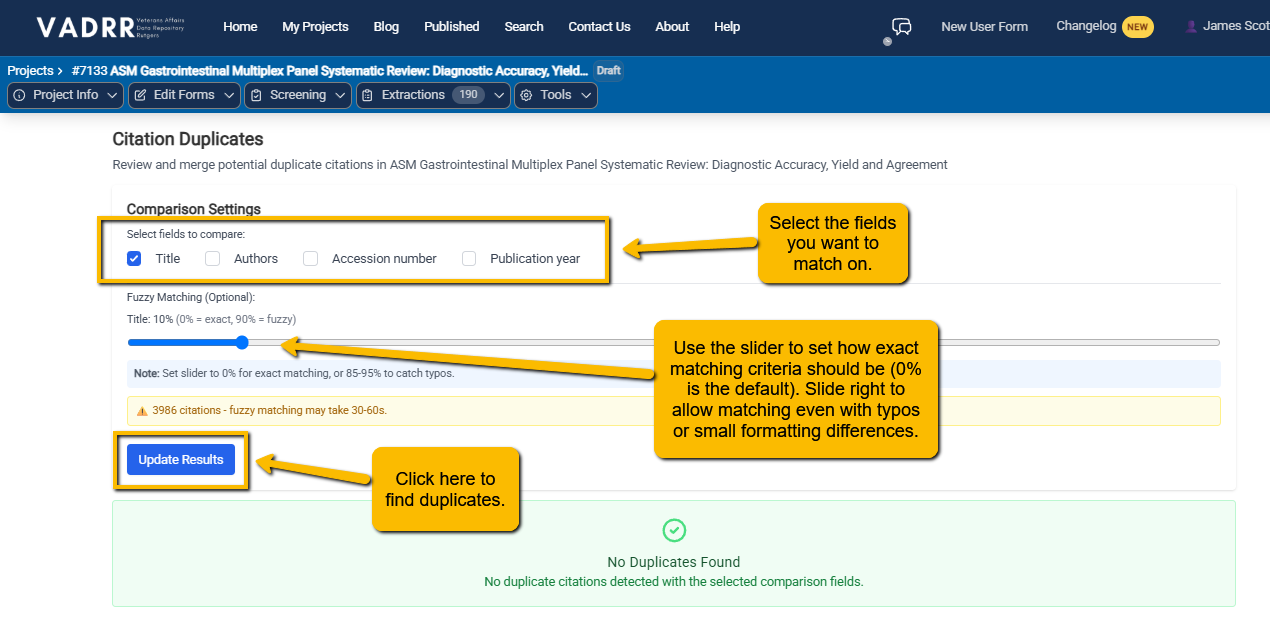
Choose which fields to compare and how strict to be, then review the duplicate groups.
¶ 1. Choose Comparison Settings
- Select fields to compare — select the fields VADRR should match on. The options are Title,
Authors, Accession number, and Publication year. Only Title is selected by default. - Fuzzy Matching (optional) — a slider appears for Title and Authors (only when that
field is selected):- 0% = exact match (default).
- 85–95% = fuzzy, which catches typos and small formatting differences.
- Click Update Results to (re)run detection.
On large projects (more than ~1,000 citations) fuzzy matching can take 30–60 seconds; VADRR warns
you when that's the case.
¶ 2. Review the Duplicate Groups
- VADRR shows how many duplicate groups it found and how many citations they cover.
- Each Duplicate Group card lists the citations it thinks are the same study, with matching
fields highlighted. - If nothing matches, you'll see a green "No Duplicates Found" message — adjust the fields or
fuzzy thresholds if you expected matches.
¶ 3. Merge
- Tick the groups you want to merge (or use Select All). The Merge Selected Groups button
stays disabled until at least one group is selected. - Click Merge Selected Groups. A confirmation dialog asks you to type CONFIRM before the
merge runs. - For each group, the citation labelled Master (Oldest) is kept; the others are merged into it,
and any associated screening labels and extracted data are preserved on the master.
Merging cannot be undone, so review the groups first. Start with exact matching (0%), then
loosen the sliders gradually if you're confident.
¶ Recommended Time to Screen
Import all your sources first, then deduplicate before you begin screening
— that way reviewers never screen the same study twice.